From a Startled Bird to a Spotted Dove: Urban Survival Rules for Middle-Aged People 🕊️
This article was last updated on: June 29, 2026 pm
From a Startled Bird to a Spotted Dove: Urban Survival Rules for Middle-Aged People 🕊️
Preface
Honestly, in recent years I’ve increasingly felt that we middle-aged people are a species living in constant contradiction.
Squeezing into the subway in the morning, I see young people laughing hysterically at short videos, while I’m mentally calculating how many mortgage payments are left, whether to renew my kid’s tutoring classes, and whether that lung nodule from last week’s checkup needs a follow-up. Your boss @mentions you in the work chat, the teacher @mentions you in the parents’ group, and your peers on social media are all showing off promotions, raises, and world travels. To be honest, sometimes I really feel like a “startled bird” — tense at the slightest disturbance, panicking when I see news about layoffs, anxious when colleagues talk about job-hopping.
Until last weekend, when I was taking a walk in my neighborhood to catch my breath, I spotted a Spotted Dove perched on someone’s windowsill. This chunky fellow, wearing a “pearl necklace” around its neck and sporting a big belly, was leisurely pecking at the neighbor’s cat food. A sparrow flew by, and it didn’t even blink. A little girl tiptoed toward it, and it just tilted its head, lazily hopping to the other side to continue foraging.
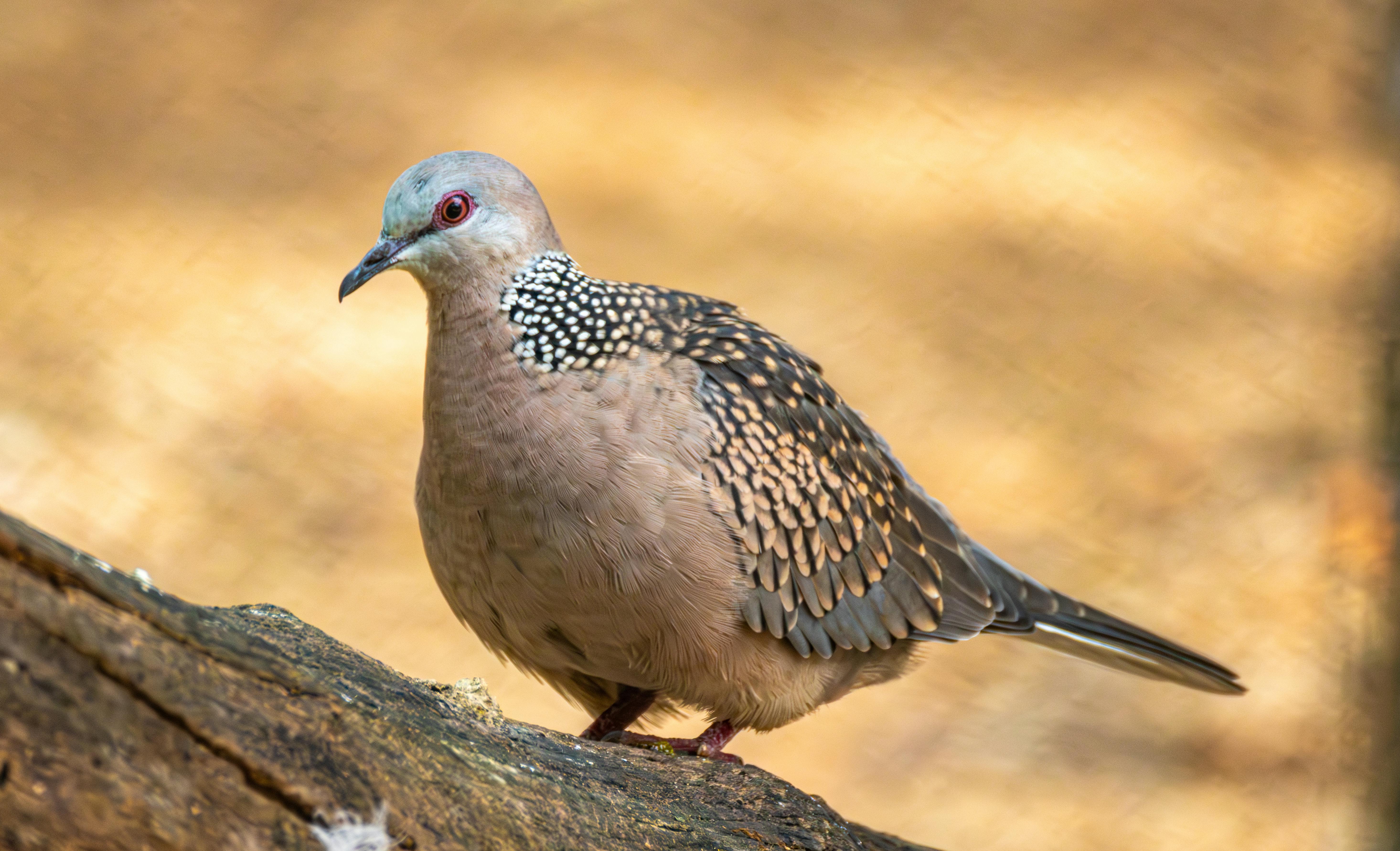
I stared at this bird for ten minutes and suddenly realized: This creature lives more wisely than I do.
The Spotted Dove — the city’s “street loafer,” jokingly called the “Husky of pigeons” or the “coo-coo monster” — has successfully transformed from a rural background to become the king of urban ecosystems in just a few decades. Meanwhile, we middle-aged people, constantly talking about “lying flat,” “involution,” and “anxiety,” can’t even match a bird.
So I seriously studied the Spotted Dove’s survival strategies and found they’re practically a ready-made textbook for middle-aged urban survival. Combined with some materials I’ve been reading recently and my own reflections, I wrote this article.
│ 📝Disclaimer:
│ This article is not a biology primer — it’s purely personal observation and reflection. If there are any biological inaccuracies, feel free to point them out. Please go easy on me 😂
1. Desensitization — From “Startled Bird” to “Composed Dove”
Spotted Doves have an amazing trait: The closer they are to humans, the less they fear them.
If you get too close, they’ll at most leisurely hop a couple of steps — they absolutely won’t fly away in a flash like sparrows. This “desensitization” behavior gives them access to abundant food resources and living space in densely populated urban environments — cat food in residential compounds, bread crumbs scattered by kids in parks, corn kernels tossed by grandmas in plazas — all their “takeout delivery.”
In contrast, we middle-aged people are far too sensitive to every little disturbance:
- The boss didn’t greet me today?
- It’s over. Is he unhappy with my year-end review?
- A colleague sent a “keep it up” emoji in the group chat?
- Is this implying my performance is bad and I need to try harder?
- Saw a post online about “being laid off at 35”?
- The sky is falling. I’m next.
│ 🤔 Interpretation from Wang Yangming’s Philosophy: This “hypersensitivity” is what Wang Yangming’s philosophy of mind calls “selfish desires blocking innate moral knowledge.” If the mind remains unmoved, all things are complete within me — when you obsess over gains and losses and fear judgment, you lose your true nature and trap yourself in a cage of anxiety.
The Spotted Dove’s “desensitization” teaches me this: Lower your sensitivity to external evaluations and proactively acquire survival resources.
What should middle-aged people do?
- First, reduce anxiety about workplace changes: Company layoffs, organizational restructuring — don’t treat yourself as a “lamb waiting for slaughter.” You’re here to work, not to atone. Speak up bravely for the promotions and raises you deserve, and plan your next move in advance.
- Second, stop caring so much about what others think: Friends at dinner saying you’re “doing average,” relatives at gatherings asking “how much do you make per month” — let it all go in one ear and out the other. Only you know whether you’re living comfortably.
- Also, stop trying to show off: A middle-aged person’s social media feed doesn’t need to be all “curated living.” Occasionally venting or sharing embarrassing moments is actually more authentic.
│ 📝Notes: This echoes what I mentioned in “Managing Technical Work Like a Business Leader” about “Bezos’s Two-Pizza Rule” — focus on the core, reduce the noise. Desensitization isn’t playing deaf and dumb; it’s allocating your energy to what truly matters.
2. Low-Energy Strategy — Reduce One Part of Selfish Desire, Recover One Part of Heavenly Principle
Another hardcore advantage of the Spotted Dove is its astonishingly low energy consumption.
They’re not good at long-distance flight, nor do they expend massive energy hunting like hawks and falcons. Their strategy is simple: Find a comfortable spot to sit, and wait for food to come to them.
In the extremely resource-rich city, this “low energy, high output” strategy is incredibly successful — they don’t need to hustle for food like swallows, nor do they need to scheme carefully like crows.
Honestly, the most common mistake middle-aged people make is trying to pile everything onto themselves:
- Ineffective socializing: Attending all kinds of networking events, drinking until your stomach bleeds, adding a bunch of WeChat contacts, yet ending up with zero real friends.
- Competitive consumption: Seeing a colleague get a new car, so you need one too; seeing a neighbor sign their kid up for equestrian lessons, so you do the same.
- Mental drain: Lying in bed at night tossing and turning, your mind full of “what if… what do I do.”
│ 📝Philosophy of Mind Reminder: “Reduce one part of selfish desire, recover one part of heavenly principle” — The Spotted Dove’s “low energy consumption” is essentially what Wang Yangming’s philosophy calls “subtraction” — reducing ineffective socializing, reducing mental drain, reducing obsession over things that don’t belong to you. Let your mental energy converge on what truly matters.
So what is the core capability?
I believe it’s the ability to “sustain output year-round.” Just like how Spotted Doves produce crop milk — they can afford to nurture.
- What is your core skill? Is it writing code, creating proposals, negotiating with clients, or managing teams? Don’t get sidetracked by “side-hustle anxiety” — first hone your bread-and-butter skill to perfection.
- Is your energy allocation reasonable? Put 80% of your energy into what generates the most value, and use the remaining 20% for rest and learning. Don’t split it 50-50 — half on mental drain, half on ineffective effort.
- Is your social circle valuable? Seriously, some circles are just hot air. Whether you process things alone, write them down, or enjoy solitude — one or two people who give you positive energy are enough.
3. Strong Adaptability — Don’t Cling to Old Patterns, Dare to Embrace Uncertainty
How strong is the Spotted Dove’s adaptability?
They originally lived in rural areas and forest edges. As urbanization progressed, they rapidly adapted to city environments. They can nest anywhere: air conditioner brackets, balcony flower pots, billboard frames, even subway station ventilation openings. They eat everything: grains, bread crumbs, insects, cat food. They can breed in any weather condition — as long as the temperature is suitable, they can lay eggs year-round.
This is practically a “no-environment-is-unsuitable” super evolution.
What middle-aged people need most is exactly this kind of strong adaptability.
│ 🎉 Wang Yangming’s philosophy says: A perfect demonstration of “unity of knowledge and action” — innate moral knowledge flowing freely, without interruption or obstruction. The Spotted Dove’s strong adaptability is precisely this state of “responding to things as they come, not clinging to any one thing” in practice.
Specifically:
- Cross-domain learning ability: The IT industry changes faster than urban redevelopment. Ten years ago you were working with WebLogic, five years ago you were doing Kubernetes, now you’re doing AI Ops. When a new technology wave arrives, don’t complain “I have to learn something new again” — instead think “mastering this buys me another three years.”
- Courage to switch jobs or careers: If you find your current track has reached a dead end, dare to change lanes. The key is — don’t wait until you’re backed into a corner before taking action.
- Age is not an excuse: Never let “I’m already 35, I can’t learn anymore” become your catchphrase.
4. Year-Round Reproduction — Continuous Output, Don’t Be a “Seasonal Player”
What impresses me most about Spotted Doves is: They breed almost year-round.
In temperate regions, they can breed from March to October; in subtropical and tropical areas, they can lay eggs, incubate, and raise chicks throughout the entire year. Some raptors breed only once a year and slack off after breeding season; but Spotted Doves are like perpetual motion machines, never stopping.
This ability to “sustain output year-round” is precisely the key for middle-aged people to escape “periodic anxiety.”
I’ve observed that many middle-aged people have this problem: They hit a cliff-like decline at certain stages.
- Working overtime like crazy before 35, then their health collapses after 35.
- Focusing on technology when young, then completely abandoning it after moving to management.
- Spending years focused on childcare after having kids, then finding themselves left behind when the kids grow up.
The Spotted Dove’s approach is clever: It doesn’t put all its eggs in one basket. Even if a nest of eggs gets eaten by predators, or chicks freeze to death, it can quickly produce another clutch. It doesn’t pursue perfectionism — it pursues continuous, uninterrupted output.
│ 📌 Practical actions:
│ - Maintain continuity in learning: Master at least one new skill per year — not through “cramming,” but by investing 30 minutes every day.
│ - Build diversified income: Salary from your main job + consulting/training/content creation on the side + investments — diversify your risk.
│ - Maintain physical health: Don’t wait until your checkup report is full of red arrows before remembering to exercise. Thirty minutes of cardio every day beats everything. (Mine is already full of red arrows, but “better late than never.”)
Summary
Writing this, I suddenly recalled Su Shi’s “Calming the Storm”:
│ Don’t mind the sound of rain pelting through the forest, why not chant and stroll at ease. A bamboo staff and straw sandals are lighter than a horse — who’s afraid? A straw cloak is all I need to weather life’s storms.
│ The biting spring wind sobers me from wine, slightly cold, yet the slanting sun greets me from the hilltop. Looking back at the bleak path I’ve traveled — returning home, there is neither storm nor shine.
How fitting:
- “A straw cloak to weather life’s storms” → Strong adaptability
- “Neither storm nor shine” → Desensitization
- “Stroll at ease” → Low-energy rhythm
The Spotted Dove teaches us four things:
- Desensitization: Lower your sensitivity to workplace changes and social evaluations; proactively acquire survival resources.
- Low-energy strategy: Reduce ineffective socializing and mental drain; focus all your mental energy on core capabilities.
- Strong adaptability: Learn across domains, dare to embrace uncertainty, don’t cling to old patterns.
- Continuous output: Maintain a year-round rhythm of learning and producing; don’t be a seasonal player.
At the end of the day, the urban survival rule for middle-aged people isn’t about becoming a “T-Rex” to conquer everything, but about being like a Spotted Dove — going with the flow without giving up effort, gentle and composed yet holding your own ground.
From “startled bird” to “composed dove” — the only gap between them is “unity of knowledge and action.”
That’s all.